
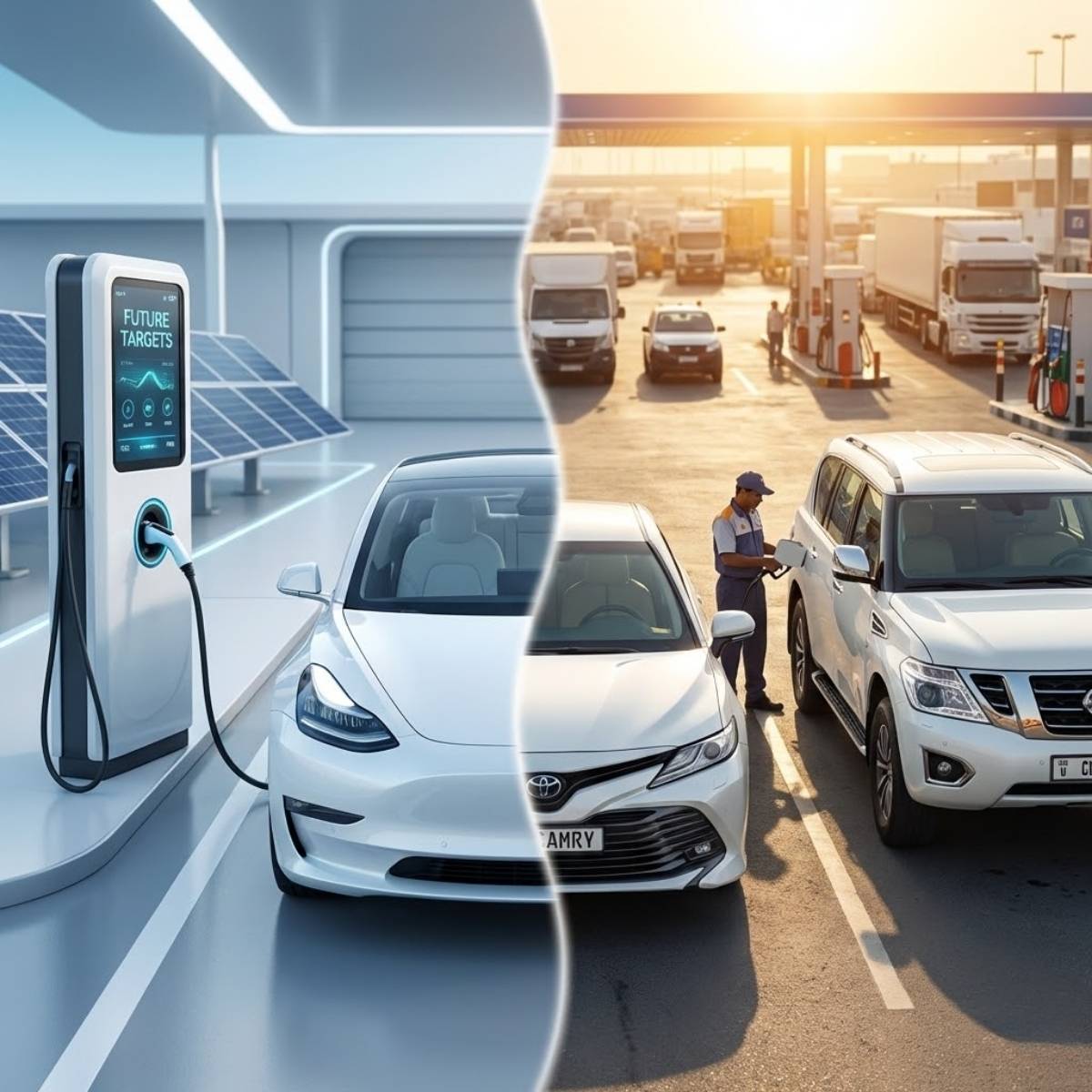
EV Curiosity, Petrol Reality: What UAE Fleet Managers Are Really Doing in 2026
In a lot of UAE boardrooms, electric vehicles are now a regular slide in the deck. There are conversations about pilots, sustainability targets and future bans on high-emission cars. But on the ground, most corporate fleets in Dubai, Abu Dhabi and the wider UAE are still running petrol and diesel vehicles, and working hard just to keep them moving.
What the UAE numbers say in 2026
Public data and recent market reports show a clear pattern: EVs are growing, but they are still a minority of the overall car and light-commercial vehicle parc in the UAE. Battery and plug-in hybrid vehicles represent a small, single-digit share of new registrations, while the vast majority of corporate car leasing and rental demand is still for internal-combustion vehicles.
- Most company fleets in the UAE remain primarily petrol and diesel, especially for field and logistics roles.
- EV adoption is concentrated in government programmes, a few large corporates and highly visible pilot projects.
- Charging infrastructure is improving in Dubai and Abu Dhabi, but is still uneven for multi-site, on-the-road teams.
- Fleet managers consistently cite uptime risk, driver routing, residual values and charging access as key concerns.
In other words, there is a lot of EV curiosity at leadership level, but the day-to-day corporate vehicle reality is still dominated by petrol and diesel leasing programmes.
What UAE fleet managers are actually doing
When you talk to operations, procurement and finance teams running corporate car rental and leasing in the UAE, the focus in 2026 is less on a full EV switch and more on tightening how the existing fleet is managed.
- Renegotiating service levels with leasing partners: response and replacement times, standby units and clear escalation paths.
- Moving from ad-hoc daily rental towards structured corporate car leasing programmes with pooled capacity and clear SLAs.
- Cleaning up data: tracking off-road time, cost per vehicle per month, and spend by site, project and cost centre.
- Running narrow EV pilots on specific routes or roles where charging and dwell time are predictable, instead of trying to convert everything at once.
For most companies, the practical question in 2026 is not “Should we be 100% electric?” but:
“How do we keep today’s petrol and diesel fleet reliable, while preparing the ground for a realistic EV rollout later?”
Stabilise the fleet first, then scale EVs
Based on how corporate vehicle programmes are evolving in Dubai, Abu Dhabi and other emirates, a pragmatic sequence is emerging for fleet and business leaders.
- Get continuity under control. Before changing fuel type, many companies are tightening continuity on existing leases: clear response and replacement targets, standby options for critical roles, and managed multi-supplier coverage so that no single vendor becomes a bottleneck.
- Make costs transparent. One contract, one monthly statement and a clean split between base leasing and variable items (fines, Salik, fuel, excess kilometres) gives finance a clear view of what corporate car rental is really costing the business.
- Design EV pilots with a tight brief. Early EV deployments are working best where the use case is narrow: fixed routes, predictable charging windows, and clear success criteria on uptime and total cost per vehicle.
This lets UAE companies keep their current petrol and diesel fleets productive, while building the data and experience they will need to make larger EV decisions later.
Where Glide fits into that picture
Glide Mobility sits as a managed, vendor-neutral layer on top of UAE leasing partners. We coordinate corporate car and van programmes across suppliers, service levels and emirates, so your vehicle operations stay stable while your strategy evolves.
For corporate fleets in Dubai, Abu Dhabi and across the UAE, that can mean fewer vendors to chase, clearer continuity when a vehicle is down, and a cleaner view of total rental and leasing spend. It also gives you a controlled framework for adding EVs when the business case is ready.
EV curiosity will keep growing, but for most UAE businesses in 2026, the real value is in running today’s corporate vehicle programme well while quietly building the next one.
Bring structure to your UAE fleet