
From Daily Rental to Corporate Leasing: When UAE Companies Should Switch
Many UAE companies start their business mobility with daily car rental. It is quick, flexible and easy to approve. A manager in Dubai or Abu Dhabi needs a vehicle, so a car is booked for a few days or a month and everyone moves on.
Over time, those short-term rentals turn into a pattern. Different teams book different vehicles with different providers. Corporate cards are used, or invoices arrive in various formats. What started as a convenient way to rent cars for the business becomes a quiet source of complexity.
Why daily car rental is where many UAE companies start
Daily and short-term rental is not “wrong”. For many growing businesses in the UAE, it is exactly what is needed at the start:
- New projects that need vehicles for a few weeks before the long-term needs are clear
- Trial periods for staff, where the company prefers not to commit to a full corporate leasing contract
- Ad-hoc trips between Emirates, site inspections or client visits where taxis are not practical
- Seasonal peaks in demand where the existing fleet is not enough
From an operations point of view, daily rental gives fast access to cars and avoids long approval cycles. From a finance point of view, it keeps vehicles off the balance sheet. It is a useful tool, especially when a company is still finding its shape in Dubai, Abu Dhabi or the wider UAE.

The challenge is that what works for five or ten vehicles on daily or weekly rental can start to break down once the business grows.
Warning signs that daily rental is holding your business back
There is no single mileage number or contract size that tells you it is time to move from daily rental to corporate leasing. Instead, the signs usually show up in how your teams feel and how your monthly numbers look.
- Fragmented invoices – Finance receives multiple invoices from different rental companies each month, often with different formats, VAT treatments and cost centres.
- Limited visibility on total spend – It becomes difficult to see how much the company is really spending on vehicle rent and rental-related charges across Dubai, Abu Dhabi and other Emirates.
- Unclear responsibility when a car is off the road – When a rented vehicle breaks down or is involved in an incident, different people are not sure who is chasing the replacement and what “good” looks like.
- Operational downtime – Supervisors and coordinators lose hours each month arranging replacements or arguing over damage, instead of serving clients or managing sites.
- Short notice price changes – Daily rental rates change with season and availability, which makes forecasting difficult for project and contract managers.
At this point, the question is not “Can we rent cars quickly?” but “Is this still the best way to support our operations?”
What changes with structured corporate vehicle leasing
Corporate vehicle leasing is still a way to rent cars and vans without owning them. The difference is structure. Instead of many short-term contracts, the company moves to agreed terms with one or more long-term leasing partners.
- Predictable monthly cost – Vehicles are on fixed-term leases with clear monthly rates, helping finance teams budget more accurately.
- Defined service levels – Replacement times, maintenance rules and roadside support are written into the contract rather than handled case by case.
- Clear allocation – Vehicles are assigned to roles, routes or sites, making it easier to see which part of the business each car or van supports.
- Better alignment with business risk – Critical vehicles can have higher cover and faster response; less critical vehicles can be on simpler terms.
- Stronger relationships – Leasing partners understand your fleet, your sites and your client commitments in the UAE, not just the next rental booking.

For many mid-sized UAE businesses, this is the point where the conversation moves from “How do we rent cars quickly?” to “What is the right corporate car leasing structure for our company?”
How to decide when to switch from daily rental to leasing
A simple way to frame the decision is to look at three areas: volume, stability and risk.
- Volume – If you consistently have 10–20 or more vehicles on rent for business use across Dubai, Abu Dhabi and the Northern Emirates, corporate leasing is usually worth a closer look.
- Stability – If your core routes, contracts and key roles are stable for 12–36 months, long-term vehicle leasing can align neatly with those commitments.
- Risk – If certain roles cannot be off the road without client penalties or service failures, relying purely on daily rental availability becomes increasingly risky.
Daily rental can still play a role for peaks and unusual journeys. The change is that your everyday corporate fleet is built on leasing, not on ad-hoc rental bookings.
Common concerns about moving to corporate leasing
When UAE companies consider moving away from pure daily rental, a few concerns come up repeatedly.
- “Will we lose flexibility?” – Corporate leasing can still include early termination options, pool vehicles and seasonal adjustments, especially when planned with the right partners.
- “Will our cost per vehicle increase?” – The headline daily rate may look cheaper on paper, but the full cost of downtime, admin and last-minute rental often tells a different story.
- “Will we have more admin, not less?” – Done properly, corporate vehicle leasing should consolidate invoices and clarify responsibilities rather than add another layer.
The goal is not simply to sign a leasing contract, but to design a structure that fits the way your company operates and grows in the UAE.
Where Glide fits between daily rental and full fleet ownership
Glide Mobility sits between daily car rental and full fleet ownership. We are a managed corporate mobility programme that works with multiple licensed leasing partners across the UAE on your behalf.
- You keep working with established leasing partners and vehicle providers.
- We help design the mix of cars, vans and service levels that matches your business risk.
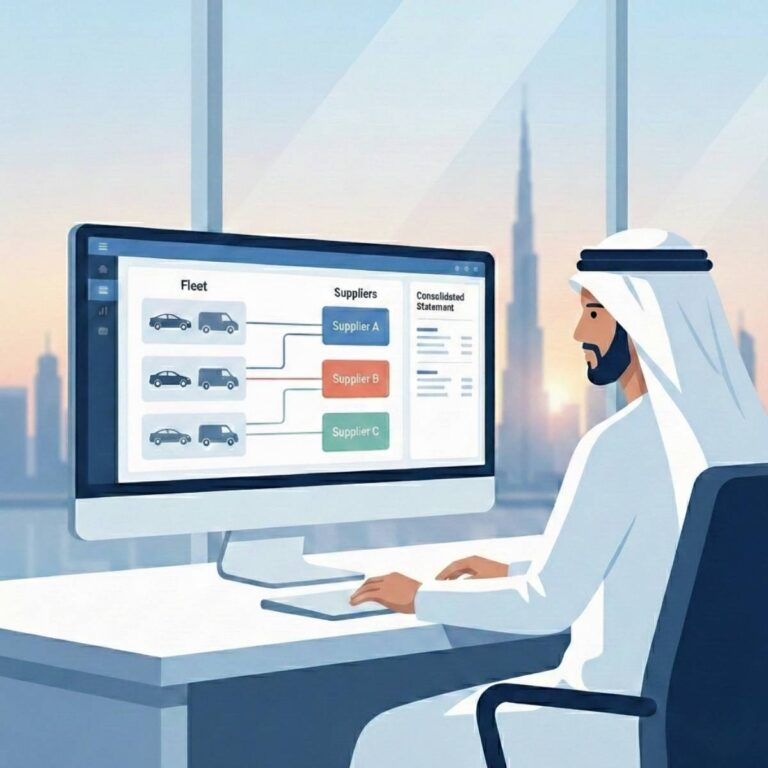
- We coordinate replacements, track downtime and bring charges into one consolidated view.

In practice, many companies in Dubai and Abu Dhabi start by moving a defined part of their business – for example, a single contract, site or region – from daily rental to a structured leasing and service model. If it works, they expand from there.
From ad-hoc rental to a mobility strategy
Daily rental will always have a place for short-term needs and edge cases. But once your organisation relies on vehicles every day to serve clients, run sites and move people around the UAE, it helps to step back and ask a different question:
Are we still just renting cars, or are we building the right corporate mobility structure for our business?
For many mid-sized companies, the answer is that it is time to move beyond ad-hoc car rental and treat corporate vehicle leasing as a core part of their business strategy in Dubai, Abu Dhabi and across the UAE.
Bring structure to your UAE fleet